Free Motion
On this page
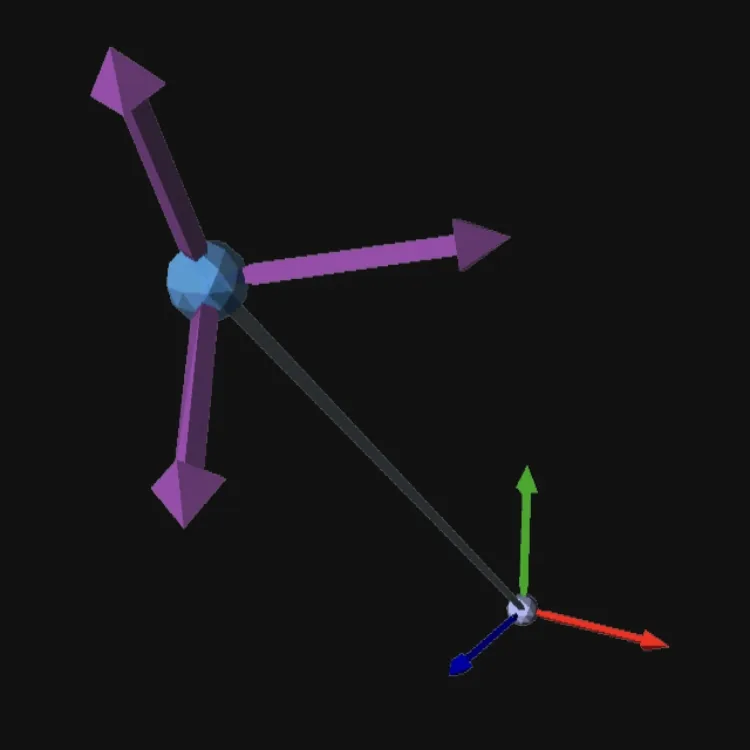
A free motion joint gives a frame all six degrees of freedom: three translations and a free orientation, like a rigid body floating in space.
Parameters
Units are shown in SI (m, kg, s, N, rad). MOMDYN does not enforce units, so any consistent set works, but angles are always in radians.
| Name | Type | Default | Units | Description |
|---|---|---|---|---|
name | str | None | — | Name given to the joint, default is uppercase characters in alphabetical order (A, B, C, ...) |
ref_point_key | str | 'origin' | — | Start point from which the vector component of the joint is defined |
ref_frame_key | str | 'inertial' | — | Reference frame in which the translational and rotational displacement components are defined |
is_form | str | 'degree of freedom' | — | 'degree of freedom' makes the value a time-varying generalized coordinate; 'constant' fixes it at the given value. |
rotation_sequence | str | 'ZYX' | — | 'ZYX', 'XYZ', 'ZXZ', 'ZYZ', 'XYX', or 'XZX', represents the Euler angle sequence used for defining equivalent initial quaternion states |
initial_t0 | numeric | 0 | m | Initial value for displacement in the x-axis of the reference frame |
initial_t1 | numeric | 0 | m | Initial value for displacement in the y-axis of the reference frame |
initial_t2 | numeric | 0 | m | Initial value for displacement in the z-axis of the reference frame |
initial_r0 | numeric | 0 | rad | Initial value for the 0th rotation angle in the Euler sequence |
initial_r1 | numeric | 0 | rad | Initial value for the 1st rotation angle in the Euler sequence |
initial_r2 | numeric | 0 | rad | Initial value for the 2nd rotation angle in the Euler sequence |
rate_t0 | numeric | 0 | m/s | Initial value for the velocity component in the x-axis of the created frame |
rate_t1 | numeric | 0 | m/s | Initial value for the velocity component in the y-axis of the created frame |
rate_t2 | numeric | 0 | m/s | Initial value for the velocity component in the z-axis of the created frame |
rate_r0 | numeric | 0 | rad/s | Initial value for angular rotation rate about the x-axis of the created frame |
rate_r1 | numeric | 0 | rad/s | Initial value for angular rotation rate about the y-axis of the created frame |
rate_r2 | numeric | 0 | rad/s | Initial value for angular rotation rate about the z-axis of the created frame |
kt0 | numeric | 0 | N/m | Stiffness in the 0th translational coordinate |
kt1 | numeric | 0 | N/m | Stiffness in the 1st translational coordinate |
kt2 | numeric | 0 | N/m | Stiffness in the 2nd translational coordinate |
kr0 | numeric | 0 | N·m/rad | Stiffness corresponding to the 0th rotation angle |
kr1 | numeric | 0 | N·m/rad | Stiffness corresponding to the 1st rotation angle |
kr2 | numeric | 0 | N·m/rad | Stiffness corresponding to the 2nd rotation angle |
ct0 | numeric | 0 | N·s/m | Damping in the 0th translational coordinate |
ct1 | numeric | 0 | N·s/m | Damping in the 1st translational coordinate |
ct2 | numeric | 0 | N·s/m | Damping in the 2nd translational coordinate |
cr0 | numeric | 0 | N·m·s/rad | Damping corresponding to the angular rate of the 0th rotation angle |
cr1 | numeric | 0 | N·m·s/rad | Damping corresponding to the angular rate of the 1st rotation angle |
cr2 | numeric | 0 | N·m·s/rad | Damping corresponding to the angular rate of the 2nd rotation angle |
equilibrium_t0 | numeric | 0 | m | Equilibrium distance in the 0th translational coordinate |
equilibrium_t1 | numeric | 0 | m | Equilibrium distance in the 1st translational coordinate |
equilibrium_t2 | numeric | 0 | m | Equilibrium distance in the 2nd translational coordinate |
equilibrium_r0 | numeric | 0 | rad | Equilibrium corresponding to the 0th rotation angle |
equilibrium_r1 | numeric | 0 | rad | Equilibrium corresponding to the 1st rotation angle |
equilibrium_r2 | numeric | 0 | rad | Equilibrium corresponding to the 2nd rotation angle |
Equations
Position of the new point relative to the start point A:
Orientation is a unit quaternion:
Sign conventions & notes
is_form is 'degree of freedom' (the value is a time-varying coordinate that the simulation solves for) or 'constant' (the value is fixed).
initial_r0, initial_r1 and initial_r2 give the starting orientation as an equivalent Euler angle sequence (rotation_sequence).
The rate_t* values are velocity components, and the rate_r* values are angular velocity components, about the axes of the created frame.