Rigid Rotation
On this page
A rigid rotation adds a new frame at a fixed orientation relative to another frame, using an Euler angle sequence. It has no degree of freedom.
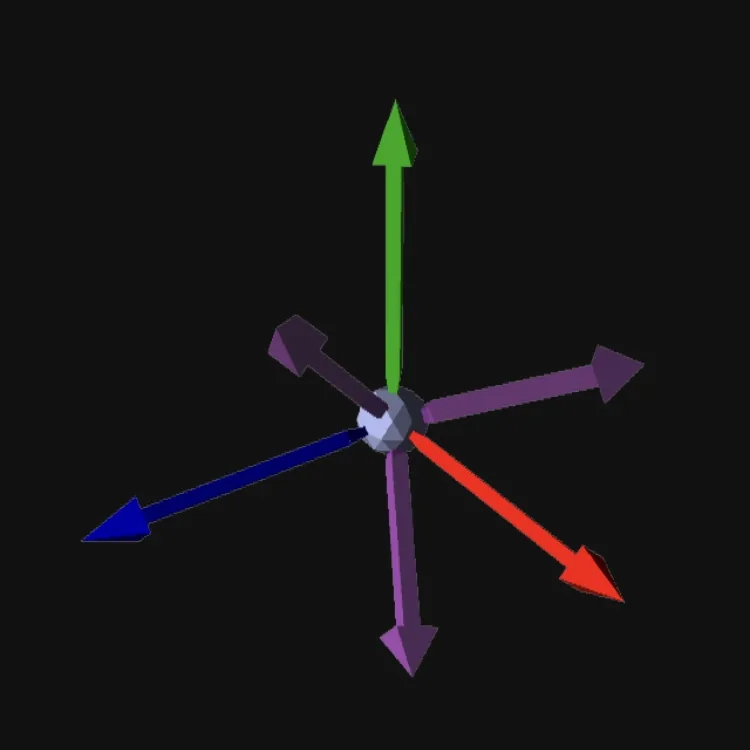
Parameters
Units are shown in SI (m, kg, s, N, rad). MOMDYN does not enforce units, so any consistent set works, but angles are always in radians.
| Name | Type | Default | Units | Description |
|---|---|---|---|---|
name | str | None | — | Name given to the rigid rotation, default is uppercase characters in alphabetical order (A, B, C, ...) |
ref_point_key | str | 'origin' | — | Point where the frame is visualized |
ref_frame_key | str | 'inertial' | — | Reference frame from which the orientation of the new frame is defined relative to |
first_angle | numeric | 0 | rad | First angle in the sequence in radians |
second_angle | numeric | 0 | rad | Second angle in the sequence in radians |
third_angle | numeric | 0 | rad | Third angle in the sequence in radians |
rotation_sequence | str | 'ZYX' | — | Euler angle sequence of the rotations, for example 'ZYX' (the default): the first angle is about the first axis, the second about the second, and so on. |
Equations
For the default ZYX sequence, with angles α, β and γ, the components in the reference frame A follow from those in the new frame B:
Sign conventions & notes
R_z, R_y and R_x are the elementary rotation matrices about each axis. Angles are in radians and positive by the right-hand rule.
Each rotation is about an axis of the frame produced by the previous rotation (a body-fixed sequence).
ref_point_key only sets where the frame is drawn.