Universal
On this page
A universal joint orients a frame with two successive rotation angles, giving two rotational degrees of freedom, like a drive-shaft coupling.
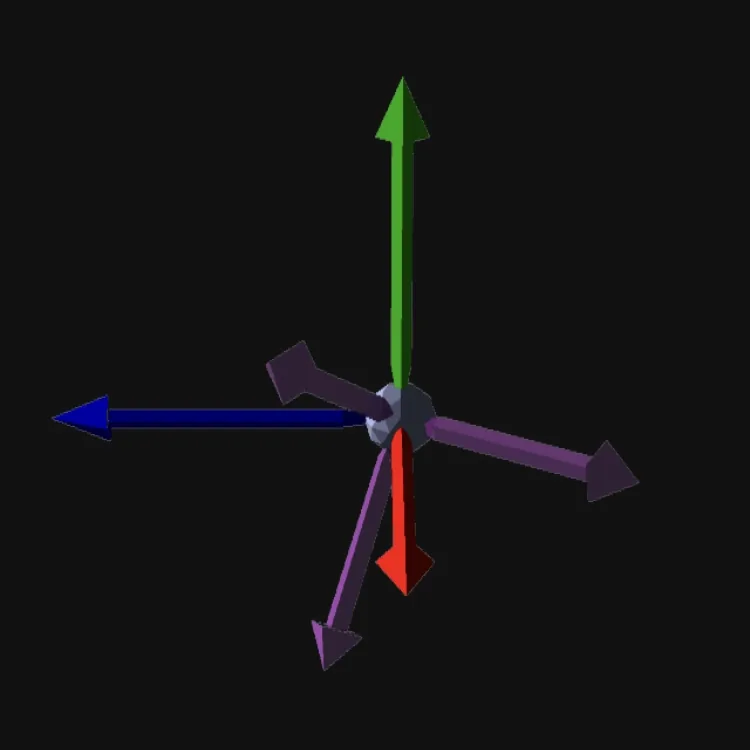
Parameters
Units are shown in SI (m, kg, s, N, rad). MOMDYN does not enforce units, so any consistent set works, but angles are always in radians.
| Name | Type | Default | Units | Description |
|---|---|---|---|---|
name | str | None | — | Name given to the joint, default is uppercase characters in alphabetical order (A, B, C, ...) |
ref_point_key | str | 'origin' | — | Start point from which the vector component of the joint is defined |
ref_frame_key | str | 'inertial' | — | Reference frame in which the translational and rotational displacement components are defined |
is_form | str | 'degree of freedom' | — | 'degree of freedom' makes the value a time-varying generalized coordinate; 'constant' fixes it at the given value. |
rotation_pair | str | 'YX' | — | 'XY', 'YX', 'YZ', 'ZY', 'ZX', or 'XZ', represents a two angle rotation sequence |
initial_r0 | numeric | 0 | rad | Initial value for the 0th rotation angle in the Euler sequence |
initial_r1 | numeric | 0 | rad | Initial value for the 1st rotation angle in the Euler sequence |
rate_r0 | numeric | 0 | rad/s | Initial value for angular rotation rate of the 0th angle |
rate_r1 | numeric | 0 | rad/s | Initial value for angular rotation rate of the 1st angle Optional stiffness, damping, and equilibrium coefficients can be used to include rotational spring-damper physics in the joint. |
kr0 | numeric | 0 | N·m/rad | Stiffness corresponding to the 0th rotation angle in the Euler sequence |
kr1 | numeric | 0 | N·m/rad | Stiffness corresponding to the 1st rotation angle in the Euler sequence |
cr0 | numeric | 0 | N·m·s/rad | Damping corresponding to the angular rotation rate about the x-axis of the created frame |
cr1 | numeric | 0 | N·m·s/rad | Stiffness corresponding to the angular rotation rate about the y-axis of the created frame |
equilibrium_r0 | numeric | 0 | rad | Equilibrium corresponding to the 0th rotation angle in the Euler sequence |
equilibrium_r1 | numeric | 0 | rad | Equilibrium corresponding to the 1st rotation angle in the Euler sequence |
Equations
For rotation_pair = 'YX', with angles θ₀ and θ₁, the frame orientation is:
Optional spring-damper torque for each angle i = 0, 1:
Sign conventions & notes
is_form is 'degree of freedom' (the value is a time-varying coordinate that the simulation solves for) or 'constant' (the value is fixed).
rotation_pair is one of 'XY', 'YX', 'YZ', 'ZY', 'ZX' or 'XZ'. The second rotation is about an axis of the frame produced by the first.
TODO: confirm that cr0 and cr1 damp the angular rates of the 0th and 1st angles (the docstring describes them in terms of the created frame’s x and y axes).