Prismatic
On this page
A prismatic joint lets a point slide along one axis of a reference frame, like a piston or a linear rail. It adds one translational degree of freedom.
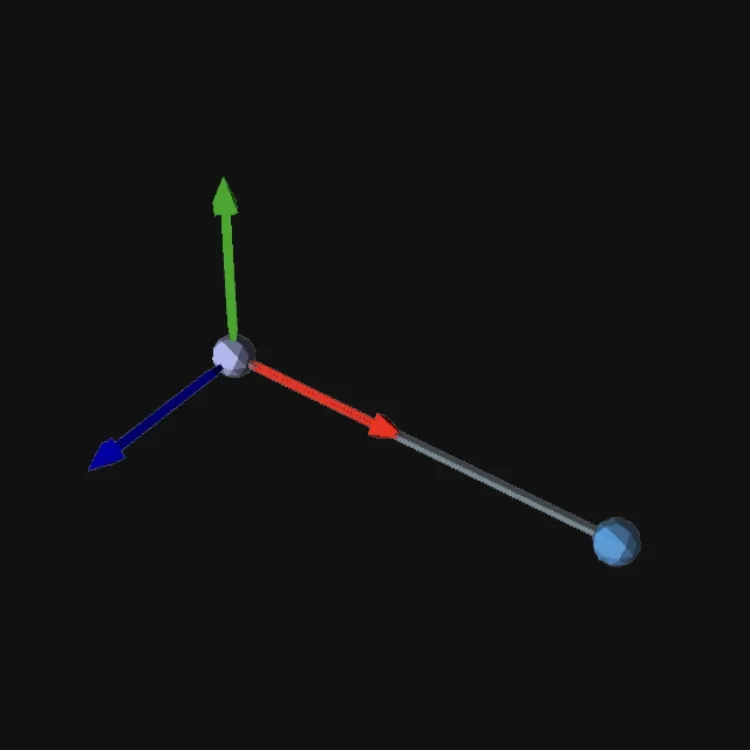
Parameters
Units are shown in SI (m, kg, s, N, rad). MOMDYN does not enforce units, so any consistent set works, but angles are always in radians.
| Name | Type | Default | Units | Description |
|---|---|---|---|---|
name | str | None | — | Name given to the joint, default is uppercase characters in alphabetical order (A, B, C, ...) |
ref_point_key | str | 'origin' | — | Start point from which the vector component of the joint is defined |
ref_frame_key | str | 'inertial' | — | Reference frame in which the motion axis is defined |
is_form | str | 'degree of freedom' | — | 'degree of freedom' makes the value a time-varying generalized coordinate; 'constant' fixes it at the given value. |
motion_axis | str | '+X' | — | Axis in which the translational motion is defined |
value | numeric | 0 | m | Initial value for the generalized coordinate |
rate | numeric | 0 | m/s | Initial value for the generalized speed |
k | numeric | 0 | N/m | Spring constant |
c | numeric | 0 | N·s/m | Damping constant |
equilibrium | numeric | 0 | m | Equilibrium distance |
Equations
Position of the new point B relative to the start point A, along the unit vector a of the motion axis:
Optional spring-damper force along the axis, restoring toward the equilibrium distance q_e:
Sign conventions & notes
is_form is 'degree of freedom' (the value is a time-varying coordinate that the simulation solves for) or 'constant' (the value is fixed).
motion_axis is '+X', '-X', '+Y', '-Y', '+Z' or '-Z' in ref_frame_key. A minus sign reverses the direction in which positive q moves the point.
value and rate are the initial coordinate q(0) and its initial speed. The spring-damper is off while k and c keep their default of 0.